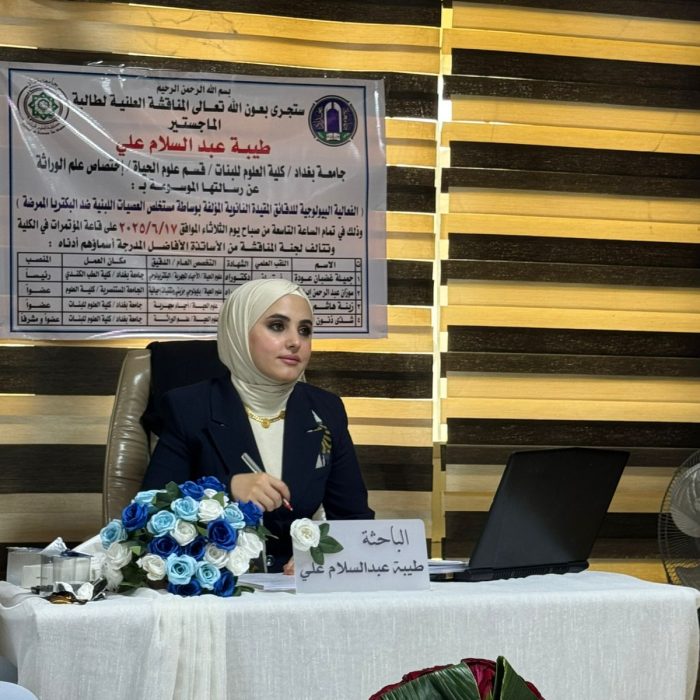
Thesis Discussion The College of Science for Women at the University of Baghdad examined a master’s thesis entitled: “Antibacterial and Antibiofilm Activity of Lactobacillus plantarum Crude Extract and Its Chitosan Nanoparticle Form Against P. aeruginosa and S. aureus”,الفعالية المضادة للبكتريا و للغشاء الحيوي للمستخلص الخام من Lactobacillus plantarum كمحفظة دقيقة مع دقائق الكيتوسان النانويةمناقشة
by
قاعة المؤتمرات
College of Science for Women
تم تحضير الجسيمات النانوية لمستخلص L. plantarum باستخدام طريقة التجلط الأيوني، وتمت دراستها باستخدام عدة تقنيات تحليلية مثل UV-Vis، FTIR، SEM، EDX، وXRD، والتي أثبتت أن الجسيمات كانت كروية، بلورية، وذات أسطح ناعمة، بحجم يتراوح بين ٤١.٢١ – ٦٣.١٨ نانومتر. أظهرت نتائج اختبار التركيز المثبط الأدنى (MIC) أن الجسيمات النانوية كانت أكثر فعالية بتركيز ١٩٦.١٥ ميكروغرام/مل، مقارنة بـ ١٥٦٢٥ ميكروغرام/مل للمستخلص الخام. كما أظهرت اختبارات النشاط المضاد لتكوين البايوفيلم عند تراكيز دون MIC أن الجسيمات النانوية كانت أكثر فاعلية، حيث قللت تكوين البايوفيلم بنسبة ٦٠% في P. aeruginosa و٣٨% في S. aureus، مقارنة بـ ٤١% و٢٠% على التوالي باستخدام المستخلص فقط.
هدفت الرسالة إلى دراسة تأثير مستخلص Lactobacillus plantarum الخام (L.pEx) وشكله المحمل بجسيمات نانوية من الكايتوسان (L.pExCsNPs) ضد العزلات السريرية لبكتيريا P. aeruginosa وS. aureus. تم جمع ١٢٢ عينة سريرية من مرضى في مستشفيات بغداد، وتم تشخيص ٣٦ عزلة (٢٩.٥%) على أنها P. aeruginosa و٢٥ عزلة (٢٠.٤%) على أنها S. aureus باستخدام تقنية الـPCR. أظهرت نتائج اختبار تكوين البايوفيلم أن جميع العزلات كانت منتجة للبايوفيلم بدرجات مختلفة. كما أظهرت اختبارات الحساسية تجاه المضادات الحيوية مقاومة عالية، خاصة ضد البنسلين بنسبة ١٠٠% في S. aureus والميروبينيم بنسبة ٦٣.٨% في P. aeruginosa.
تم قياس تعبير الجينات المرتبطة بالبايوفيلم (algD في P. aeruginosa وicaA في S. aureus) باستخدام تقنية RT-qPCR. وأظهرت النتائج أن المعاملة بـ L.pEx قللت من التعبير الجيني لـ algD إلى ٠.٠٦٣٣ وicaA إلى ٠.٧٣٢٠، بينما كانت التأثيرات أقوى باستخدام L.pExCsNPs، حيث بلغ التعبير الجيني لـ algD حوالي ٠.٠٠١٥ وicaA حوالي ٠.١٨٣٠. وقد كانت هذه النتائج ذات دلالة إحصائية (P ≤ ٠.٠٥)، مما يشير إلى التأثير التثبيطي الكبير للجسيمات النانوية مقارنة بالمستخلص الخام، خاصة على جين algD.
التقدير النهائي: امتياز.
L.pEx was encapsulated into chitosan nanoparticles using the ionic gelation method. Characterization using UV-Vis, FTIR, SEM, EDX, and XRD confirmed the production of spherical, crystalline nanoparticles with smooth surfaces and a diameter range of 41.21–63.18 nm. MIC results showed that L.pExCsNPs had a significantly lower MIC (196.15 µg/ml) compared to L.pEx (15625 µg/ml), indicating enhanced antibacterial efficacy. Anti-biofilm testing at sub-MIC concentrations demonstrated superior inhibition by L.pExCsNPs, reducing biofilm formation by 60% in P. aeruginosa and 38% in S. aureus, compared to 41% and 20% respectively with the crude extract.
The thesis investigated the antibacterial and antibiofilm effects of Lactobacillus plantarum crude extract (L.pEx) and its chitosan nanoparticle formulation (L.pExCsNPs) against clinical isolates of P. aeruginosa and S. aureus. A total of 122 clinical specimens were collected from patients in Baghdad hospitals, resulting in 36 isolates of P. aeruginosa (29.5%) and 25 isolates of S. aureus (20.4%). PCR confirmed the identity of isolates using housekeeping genes (rpsL and 16S rRNA). Biofilm production was observed in all isolates with varying degrees of strength. Antibiotic susceptibility tests revealed high resistance in both bacterial species, most notably to Penicillin (100%) in S. aureus and Meropenem (63.8%) in P. aeruginosa.
Gene expression of the biofilm-associated genes algD (P. aeruginosa) and icaA (S. aureus) was assessed using qRT-PCR. L.pEx treatment resulted in mean fold changes of 0.0633 (algD) and 0.7320 (icaA), while L.pExCsNPs treatment showed stronger inhibition with fold changes of 0.0015 (algD) and 0.1830 (icaA). The reductions were statistically significant (P ≤ 0.05), confirming the greater suppressive effect of the nanoparticle formulation, especially on algD expression.
Final Grade: Excellent.