Evaluation of Immunological,Hematological and Hormonal markerﹸs inPlaque Psoriasis Iraqi Patients) of the student (Aaraf Harith Abdul Wahhabاطروحة دكتوراه تقييم المؤشرات المناعية والدمية والهرمونية في مرضى الصدفية اللويحية العراقيينمناقشة
by
قسم علوم الحياةاعراق
College of Science for Women
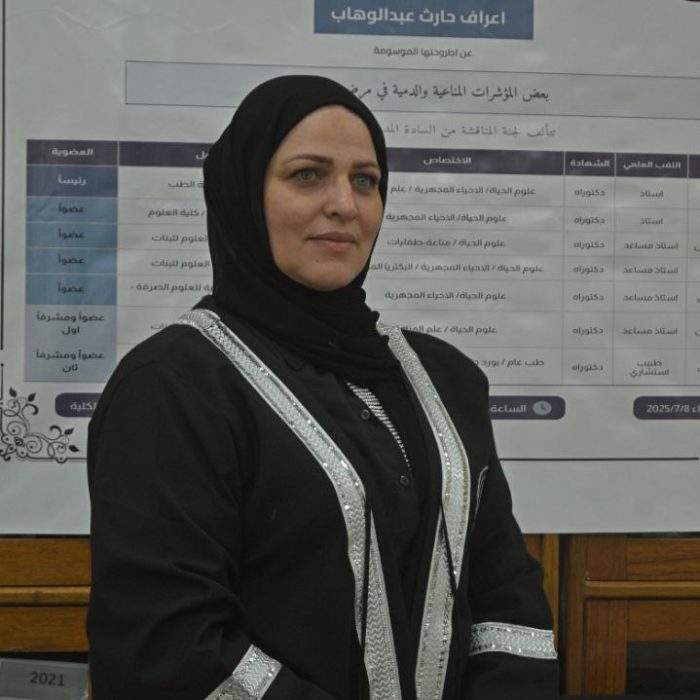
تضمنت الدراسة جمع عينات دم من ١٠٠ مريض و٤٠ سيطرة واجراءتحليل الدم للكشف عن اعداد كريات الدم البيضاء والهيموغلوبين والصفائح الدموية وكريات الدم الحمراء ومقارنتهم بالسيطرة أيضا اجراء الفحص المناعي للمرضى للكشف عن انترلوكين ١٠وانترلوكين ٢٢وانترلوكين ٣٦ عن طريق فحص الالايزا وتحليل سي دي ٣وسي دي ٤وسي دي ٨ عن طريق جهاز الفلوو سايتومتري ومقارنتهم بالسيطرة وأيضا اجراء التحليل الهرموني لهرمونات الغدة الدرقية والكورتزول للمرضى ومقارنتهم بالسيطرة ومن ثم إيجاد العلاقة بين المؤشرات المناعية جميعا
وتهدف الاطروحة الى تقييم بعض المؤشرات المناعية والدمية والهرمونية وعلاقة بعض المؤشرات ببعضها للمرضى المصابين لداء الصدفية اللويحي .
كشفت هذه الدراسة أن الإناث أكثر شيوعًا من الذكور بين مرضى الصدفية والمجموعة الضابطة. أظهر مرضى الصدفية ارتفاعًا ملحوظًا في مؤشر كتلة الجسم مقارنةً بالمجموعة الضابطة السليمة. وتُعدّ الفئة العمرية ٣١-٤٥ عامًا الأكثر شيوعًا للإصابة بالصدفية. كما لوحظت زيادة في التوتر لدى المرضى مقارنةً بالمجموعة الضابطة. وُجدت فروق ذات دلالة إحصائية في إجمالي عدد خلايا الدم البيضاء، ونسبة العدلات، واللمفاويات، والحمضات، والوحيدات، والقاعدية لدى مجموعة المرضى مقارنةً بالمجموعة الضابطة السليمة. كما أظهر عدد الصفائح الدموية تباينًا كبيرًا بين الفئات العمرية. لوحظ أعلى متوسط لـ PLT في الفئة العمرية ٤٦-٦٠ عامًا. مناعيًا، كانت مستويات الإنترلوكين-١٠ (IL-١٠) أقل بشكل ملحوظ لدى المرضى مقارنةً بالضوابط. وعلى العكس من ذلك، كانت مستويات الإنترلوكين-٢٢ (IL-٢٢) والإنترلوكين-٣٦ (IL-٣٦) أعلى بشكل ملحوظ لدى المرضى. وفيما يتعلق بالتحليل الهرموني، لم تكن هناك فروق كبيرة في مستويات T٣ أو T٤ أو TSH بين المرضى والضوابط، بينما كانت مستويات الكورتيزول أقل بشكل كبير لدى المرضى. أظهرت الدراسة الحالية أن نسب CD٣ وCD٤ وCD٨ في الدم لها فرق كبير بين المرضى ومجموعة الضبط الصحية.
التقدير : تقدير جيد .
The study included collecting blood samples from 100 patients and 40 controls and conducting blood analysis to detect the numbers of white blood cells, hemoglobin, platelets, and red blood cells and comparing them with the control group. Also, conducting an immune examination for patients to detect interleukin 10, interleukin 22, and interleukin 36 by ELISA examination, and analyzing CD3, CD4, and CD8 by Flow Cytometry device and comparing them with the control group. Also, conducting a hormonal analysis for thyroid hormones and cortisol for patients and comparing them with the control group, and then finding the relationship between all immune indicators.
The study’s objectives are to assess the levels of IL-10,IL-22,IL36 and CD3,CD4,CD8 in the blood of Patients of psoriasis and to investigate their potential association with the disease. It also looks at hematological factors to see if any changes are specific to the disease. Additionally, the study looks into the statistical link between psoriasis and subclinical hormones by checking thyroid function tests T3, T4, TSH, cortisol levels , also looked at to see how the correlation with psoriasis.
The present investigation revealed that the females were more frequently observed than Males among psoriasis patients and Control. Psoriasis patients exhibited significantly higher (BMI) compared to healthy control groups. The age group 31-45 year is the most frequent with psoriasis. Stress was more frequently shown in patients in comparison with control.There were significant differences in total WBCs Counts, Neutrophils %, Lymphocytes %, Eosinophil’s %, Monocytes % and Basophil % in patients group compared with healthy control group.Platelet count showed significant variation across the age groups. The highest mean PLT was observed in the 46-60 age group.Immunologically, interleukin-10 (IL-10) levels were markedly lower in patients in comparison with controls Conversely, interleukin-22 (IL-22) and interleukin-36 (IL-36) levels were significantly higher in patients.Regarding hormonal analysis, there were no significant differences in T3, T4, or TSH levels between patients and controls while , cortisol levels were significantly lower in patients. CD3, CD4, and CD8 percentages in blood have a significant difference between the patients and healthy control group .
The final grade: VeryGood